

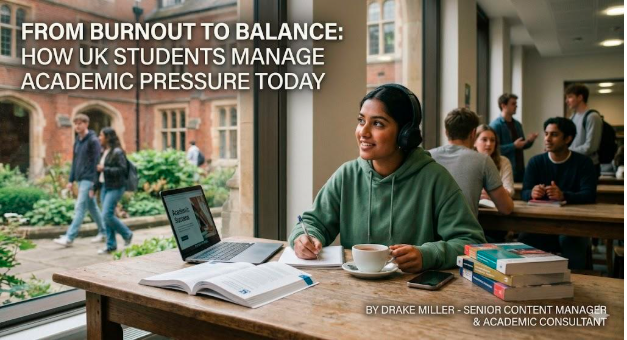
By Drake Miller – Senior Content Manager & Academic Consultant
The image of the “stressed student” has long been a staple of British university life—late-night library sessions, caffeine-fueled revision marathons, and the frantic rush to meet UCAS deadlines. However, as we move through 2026, the narrative has shifted from mere “stress” to a systemic crisis of burnout.
With the cost-of-living crisis hitting student pockets, the competitive nature of the post-graduate job market, and the lingering effects of disrupted learning, UK students are facing a unique set of pressures. Many are now turning to reliable assignment help UK services to better manage demanding coursework while maintaining their mental well-being. Yet, amidst these challenges, a new movement is emerging. From Sixth Formers to PhD candidates, students are redefining their relationship with productivity. Here is how the modern UK student is navigating the journey from burnout to balance.
The Burnout Epidemic: Why Now?
Burnout is more than just feeling tired; it is a state of emotional, physical, and mental exhaustion caused by excessive and prolonged stress. According to 2026 reports from the National Union of Students (NUS), a staggering percentage of students report that their mental health has worsened since starting their course. Several factors contribute to this “pressure cooker” environment:
- The “Always-On” Culture: Social media has created a digital shop window where students constantly compare their behind-the-scenes struggles with everyone else’s highlight reels.
- Academic Escalation: The stakes feel higher than ever. A 2:1 degree is no longer just a “good grade”; it is often the bare minimum requirement for even entry-level graduate schemes in the UK’s top firms.
- The Legacy of Disruption: Many students currently in university experienced formative years under hybrid learning, leading to “imposter syndrome” when faced with traditional, high-stakes invigilated exams.
The Financial Anxiety Factor (2026 Context)
One cannot discuss student burnout in the UK without addressing the economic reality. With maintenance loans often failing to cover basic rent in student hubs like London, Manchester, or Bristol, financial anxiety has become a primary driver of exhaustion.
Recent data suggests that students are navigating a gap where inflation outpaces loan increases. Many are now balancing 20+ hours a week in part-time service or gig-economy jobs alongside full-time degrees. This “double shift” leaves little room for the “rest and play” traditionally associated with the university experience. When your survival depends on a shift at a local cafe and your future depends on a First-Class dissertation, “balance” can feel like a luxury. This is particularly true for those tackling complex quantitative subjects, where the pressure to maintain accuracy while exhausted can lead many to seek specialized accounting assignment help to ensure their grades don’t slip during busy work weeks.
Redefining Balance: The Shift in Mindset
The modern UK student is increasingly rejecting the “hustle culture” that glorified sleep deprivation. Instead, they are adopting more sustainable methods to achieve academic success.
See also: Decision-Focused Business Intelligence Overview on 570010581, 608628079, 6944599197,
1. Smart Outsourcing and Academic Support
One of the most significant shifts is the move toward utilizing professional academic resources. Students are realizing that they don’t have to struggle in isolation. Whether it’s seeking a tutor for complex STEM modules or using reliable services for assignment help in the UK to understand complex essay structures, academic support has become a strategic tool for time management.
By leveraging expert guidance on essay structures, students can bridge the gap between their lectures and their assignments, reducing the “blank page” anxiety that often triggers burnout. This isn’t about taking the easy way out; it’s about working smarter and knowing when to ask for a helping hand to maintain one’s mental equilibrium.
2. The Rise of “Slow Productivity”
Influenced by academic experts and digital minimalists, many students are moving away from frantic multitasking. The “Pomodoro Technique” remains a staple, but it is being evolved into “deep work” sessions.
Students are learning that four hours of focused, distraction-free study is more effective than twelve hours of “pseudo-working” while scrolling through TikTok. This philosophy, dubbed Slow Productivity, emphasizes quality over quantity and the importance of finishing one task before starting another.
3. Boundaries with Technology
Ironically, the very technology that contributes to burnout is being used to fight it. App blockers like Forest or Freedom are becoming essential kit for UK students. Many are also adopting “digital sabbaticals” on weekends to disconnect from University WhatsApp groups and Canvas notifications, allowing their brains to truly reset.
Practical Strategies for Navigating Academic Pressure
If you are a High School or University student feeling the weight of your workload, here are the evidence-based strategies currently being used on campuses across the UK to regain balance:
Audit Your Time
We often overestimate how much we work and underestimate how much we procrastinate. For one week, track your hours. You might find that your “study time” includes two hours of scrolling. By tightening your focus, you can actually finish your work earlier and enjoy guilt-free leisure time.
Prioritize Sleep Over “Cramming”
Research from the University of Oxford and other leading institutions consistently shows that sleep deprivation nukes cognitive function. A student who sleeps 8 hours and studies for 2 will almost always outperform a student who sleeps 2 hours and studies for 8. Sleep is where memory consolidation happens—without it, your revision won’t stick.
Utilize University Services
Every UK university has a Wellbeing or Student Support hub. From counseling services to extensions based on “mitigating circumstances,” these resources are there to be used. High school students should similarly lean on pastoral leads or career advisors when the UCAS process becomes overwhelming.
Movement as Medicine
The “Freshers’ 15” might be a myth, but the sedentary lifestyle of a student is real. UK students are increasingly joining “Social Run Clubs” or taking part in university “Active Wellbeing” programs. Physical activity is one of the fastest ways to clear cortisol—the stress hormone—from your system.
The Role of Community
Perhaps the most effective antidote to burnout is community. Loneliness is a major driver of academic stress. Whether it’s a study group in the Student Union or a niche hobby society, connecting with peers who are facing the same deadlines provides a sense of “shared struggle.”
Looking Forward: A Healthy Academic Future
The transition from high school to university, and eventually into the workplace, is a marathon, not a sprint. The “Burnout to Balance” movement among UK students is a sign of maturity. It shows a generation that values its mental health as much as its transcript.
By setting boundaries, seeking academic support for university students when needed, and prioritizing self-care, students are proving that it is possible to achieve a First-Class degree without sacrificing their sanity.
Final Thoughts for the UK Student
If you’re feeling overwhelmed today, take a breath. Academic pressure is a season, not a life sentence. Success is not measured by how much you suffer, but by how sustainably you grow. Welcome to the era of the balanced student.
Frequently Asked Questions
Q.1 How do I know if I am experiencing burnout or just normal stress?
Stress is usually tied to a specific deadline and dissipates once it’s over. Burnout feels like a permanent state of “emptiness” and lack of motivation, even after a deadline has passed.
Q.2 Is using academic help services considered “cheating”?
When used correctly as a learning aid—to understand structure, research methods, or complex concepts—academic support services are a legitimate part of a student’s “study toolkit,” much like a private tutor.
Q.3 What is the best way to handle UCAS application stress?
Break the process into micro-tasks. Focus on the personal statement one week, and your course choices the next. Don’t leave it all until the January deadline!
About the Author
Drake Miller is a senior content manager and academic consultant with over a decade of experience in higher education strategy. Based in the UK, Drake specializes in student wellness, digital marketing for educational platforms, and the intersection of technology and academia. He is a passionate advocate for E-E-A-T (Experience, Expertise, Authoritativeness, and Trustworthiness) in educational content, ensuring that students receive high-quality, reliable information to guide their academic journeys.